
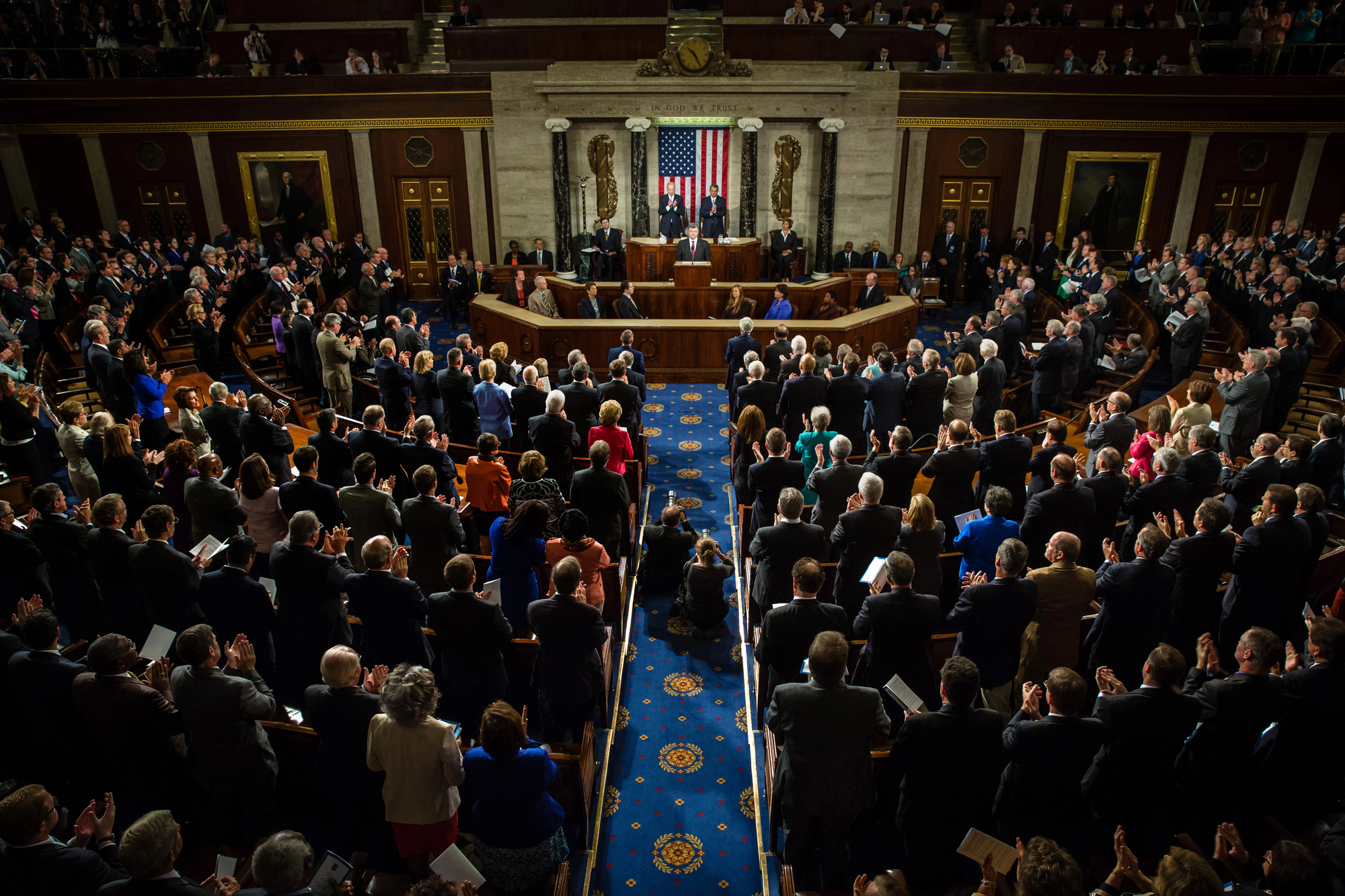

Congress controls government spending through its constitutional “power of the purse,” authorizing taxes and appropriations via legislation, setting overall budget frameworks with resolutions, passing annual spending bills, and overseeing executive agencies, ensuring funds are spent as directed through processes like appropriations and budget control acts, acting as a key check on presidential power.
Constitutional Authority
- “Power of the Purse”: Article I of the Constitution grants Congress the exclusive power to tax, spend, and borrow money.
- Appropriations: No money can be spent from the Treasury without a law passed by Congress authorizing it.
Legislative Process & Tools
- Budget Resolution: The Congressional Budget Act of 1974 established a process for Congress to create an overall budget plan, setting spending limits and priorities.
- Authorization & Appropriation Bills: Congress passes laws authorizing specific programs and then passes annual appropriations bills to fund them, controlling both discretionary and mandatory spending.
- Budget & Appropriations Committees: These specialized committees in the House and Senate develop budget resolutions and oversee spending.
Oversight & Checks
- Impoundment Control Act (1974): Limits the President’s ability to withhold funds Congress has appropriated, requiring presidential requests for rescission to be approved by Congress.
- Review & Reporting: Congress receives regular reports from agencies (via Treasury/OMB) and can cut funding or deny resources for specific activities, influencing executive policy.
Key Mechanisms
Oversight: Regular hearings and reviews hold agencies accountable for spending.
Taxes: Congress enacts laws to raise revenue.
Spending Bills: Annual bills fund government operations and programs.
Continuing Resolutions (CRs): Temporary funding measures passed if full-year budgets aren’t enacted, preventing shutdowns.
The constitutional lock: no money without a law
Congress’s spending power is built into the Constitution, then reinforced by decades of budget law and enforcement practice.
The Appropriations Clause is the hard stop
Article I says no money leaves the Treasury unless an appropriation is made by law. That line is not poetry. It is a control system. If Congress has not passed an appropriation, the executive branch does not have legal permission to spend for that purpose, no matter how urgent the program feels or how popular it is.
That is why modern spending fights often look theatrical but function like a valve. Congress can open the valve wide, narrow it, attach conditions, or shut it. When people talk about “power of the purse,” this is the mechanism they mean, not a vague idea of influence.
It also sets up a constant friction point: presidents run the executive branch, yet Congress writes the legal instructions for what money can be used for. That tension never goes away, it just moves between topics.
The House starts the money, the Senate reshapes it
In practice, the House of Representatives treats spending as its home turf, partly from constitutional design and partly from institutional habit. It frames itself as the chamber closest to taxpayers, which is why it guards the first move on major funding measures.
The Senate then becomes the arena where spending bills get edited into something that can survive. Senate procedure, Senate bargaining, and the need to gather enough votes give the chamber enormous leverage over what ends up funded and what ends up cut, delayed, fenced in, or traded away.
So even when a fight looks like Congress versus the president, plenty of the real control sits inside Congress, in the gap between the House and Senate versions of the same bill.
What an appropriation really does
An appropriation is not a press release about priorities. It is legal authority for agencies to incur obligations and make payments. That distinction matters: signing a contract is an obligation; paying the invoice is an expenditure. Appropriations law cares about both steps.
Appropriations also have three core limits that Congress can tighten or loosen: purpose (what it can be used for), time (how long the authority lasts), and amount (the ceiling). Those limits are the reason lawmakers can steer outcomes without rewriting the entire structure of an agency.
When agencies cross those lines, it is not a policy dispute. It is a legal problem.
The annual machinery: from budget framework to 12 spending bills
The U.S. budget cycle is a yearly drill built around the federal fiscal year (financial year), which runs October 1 to September 30.
The president proposes, Congress disposes
The White House submits a budget request, built through the Office of Management and Budget, and it sets the administration’s preferred numbers and priorities. It also signals what the president would like agencies to do. None of it spends a dollar by itself. Congress still has to pass authorisations and appropriations to turn preferences into legal authority.
This is where readers often get misled: headlines treat the president’s budget like a funding decision. It is closer to an opening offer.
Congress then pulls in its own referee: the Congressional Budget Office. CBO cost estimates and baselines shape what lawmakers say a bill “costs,” which becomes the language of leverage in negotiations.
The budget resolution and spending allocations
Congress often starts with a budget resolution, which sets totals and assumptions. It is a blueprint inside Congress, not a law signed by the president. The budget resolution can still bite, because it drives allocations that limit what committees can write into bills.
The key internal controls are allocations, including 302(a) and 302(b) levels. Put simply, 302(b) divides the pot across the appropriations subcommittees and becomes an enforceable ceiling in the appropriations process.
That means the first big spending decision is often not a program cut. It is a cap that forces every later choice to fit under a hard number.
The 12 regular appropriations bills
Most day-to-day federal operations depend on annual appropriations. Congress splits that work into 12 regular appropriations bills, each tied to a slice of government.
Those bills are where Congress exercises fine control: specific funding levels, report language, restrictions on how money can be used, deadlines, and compliance requirements. The more detailed the bill, the tighter Congress holds the steering wheel.
When Congress finishes those bills on time, the system looks boring. When it does not, the system becomes a hostage negotiation.
When the clock runs out: continuing resolutions, shutdowns, and giant packages
Late appropriations are the normal state of play in modern Washington. Congress then uses temporary tools to stop the government from hitting the legal wall.
Continuing resolutions keep the lights on, with strings attached
A continuing resolution, usually called a CR, is a temporary appropriations law. It funds government operations for a limited period when regular appropriations bills are not enacted by October 1.
CRs often extend prior year funding levels and restrict new starts, which creates real operational damage: agencies delay contracts, slow hiring, freeze projects, and avoid committing to multi month plans. GAO has documented how repeated CRs disrupt planning and raise costs through delay and churn.
So a CR is not neutral. It is a choice, and it shifts power toward short term bargaining.
Shutdowns happen when appropriations lapse
If appropriations and a CR both fail, the result is a funding gap. Federal agencies then face the Antideficiency Act, which blocks them from obligating or spending money without appropriations, with narrow exceptions. That is the legal engine behind shutdowns.
During a shutdown, agencies separate activities into excepted work and work that stops. Many staff are furloughed, contracts pause, grants stall, and the backlog grows. The shutdown ends when Congress and the president enact funding, often through a CR or a large package.
Shutdowns look like politics. Under the hood they are the spending law doing exactly what it was designed to do, forcing action by denying agencies the ability to operate without authorisation.
Omnibus and supplemental bills are the pressure release valves
When time runs short, Congress often bundles multiple appropriations bills into one large package, sometimes called an omnibus. It is a way to gather votes by linking unrelated priorities and moving a single vehicle through both chambers.
Congress also passes supplemental appropriations for unexpected needs, often emergencies. Those bills can move fast, and that speed is part of their political value.
This is one reason spending fights feel constant: Congress has several ways to fund government, and each method changes the leverage map.
Authorisation versus appropriation: the quiet power move
A big share of spending control sits in a distinction that gets ignored in most coverage: authorising laws and appropriations laws do different jobs.
Authorisations set rules, appropriations supply money
An authorisation can create a program, set its structure, and permit future appropriations. It can also impose conditions on how an agency runs the program. An appropriation provides the actual budget authority to spend. One without the other produces a program that exists on paper, or money that cannot legally be used for the intended activity.
Congress can exploit that gap. Authorisers can threaten to rewrite or restrict a program. Appropriators can choke funding, fence it in, or attach conditions in spending bills.
This is why agencies often treat the appropriations committees with the same seriousness as their policy committees. Funding language can change behaviour overnight.
Discretionary versus mandatory spending
Annual appropriations mostly cover discretionary spending. Mandatory spending flows through standing law, including large programs with automatic outlays unless Congress changes the law.
Congress still controls mandatory spending, just through a different route: it has to pass legislation that changes eligibility rules, benefit formulas, or program structure. That is harder politically, but the control exists.
So the phrase “on autopilot” is misleading. Mandatory spending runs on legal instructions written by Congress, and Congress can rewrite them.
Reconciliation: the Senate shortcut that shapes spending
Budget reconciliation is a procedure created under the Congressional Budget Act framework that can speed certain budget related bills through the Senate with limited debate.
That matters for spending control because it changes the vote math. Reconciliation can make it easier to pass major fiscal changes, including shifts to taxes and mandatory spending, when the Senate is closely divided.
So when people say Congress “cannot get anything done,” it often means Congress is choosing not to use the tools that make fiscal change easier.
Oversight and enforcement: how Congress polices the money
Passing a spending bill is only the first act. Congress keeps control through enforcement, audits, and legal constraints that bind agencies after the vote.
GAO and the Red Book define the guardrails
The Government Accountability Office functions as Congress’s watchdog on public money, and its appropriations law work creates a large body of guidance on what agencies can and cannot do with federal funds.
GAO’s Principles of Federal Appropriations Law, known as the Red Book, is the core reference for fiscal law questions inside government. It breaks down the legal rules for purpose, time, amount, obligations, and proper use.
That matters in practical terms. When an agency tries to repurpose funds, stretch a time limit, or treat a restriction as optional, it can trigger GAO findings, inspector general scrutiny, and congressional hearings.
The Antideficiency Act is the enforcement hammer
The Antideficiency Act prohibits agencies from obligating or spending in advance of appropriations or beyond the amounts provided. That rule forces agencies to stop many activities when funding lapses, and it shapes shutdown planning.
It also forces discipline inside a funded year. Agencies have to track obligations, manage allotments, and avoid running ahead of the legal authority Congress granted.
So “Congress controls spending” is not only about votes on big bills. It is baked into daily compliance requirements that agencies cannot ignore.
Oversight is a spending tool, not a sideshow
Committees hold hearings, demand documents, issue subpoenas, and require reports tied to appropriations language. Oversight is how Congress checks whether money is used the way lawmakers intended.
The Constitution also requires regular reporting of receipts and expenditures, reinforcing the idea that spending must be traceable and reviewable, not just authorised.
When oversight is aggressive, agencies adjust behaviour fast. When oversight is weak, agencies gain room to interpret, delay, or steer around congressional intent.
The president’s limits: veto power, plus the spend or do not spend fight
The president has leverage in funding fights, yet the basic structure keeps Congress in the driver’s seat.
The veto shapes the negotiation
Appropriations bills still go through the same lawmaking pipeline. The president can sign or veto. That means Congress often builds funding packages that can survive a veto threat or that force a public choice.
This is where shutdown politics lives: a veto or a threatened veto can push Congress toward CRs, or push both sides into a high stakes negotiation over a deadline.
Even so, the veto does not create spending authority. It only blocks or approves what Congress sends.
Withholding funds triggers a legal war
Presidents sometimes try to slow, delay, or cancel spending that Congress has appropriated. Congress responded to past abuse by tightening the rules through the Impoundment Control Act, which sets procedures for rescissions and deferrals and limits unilateral withholding.
Under that framework, if a president proposes to permanently cancel funds, Congress has to approve within the statutory window or the funds remain available for obligation under the terms of the appropriation.
That is why modern fights over “freezing” money turn into court fights and constitutional arguments. They are not only about policy. They are about who decides whether an appropriation actually gets used.
OMB can manage pace, not permission
The executive branch still manages execution. It sets schedules, administers grants, signs contracts, and phases spending across the fiscal year.
Yet those implementation choices sit inside the box Congress built: the amount, the purpose, the time period, and the conditions in the appropriations act. The legal authority to spend comes from Congress, and the Antideficiency Act and appropriations law keep agencies inside that boundary.
Congress controls federal spending by writing the legal permission slip for every dollar, then enforcing it through deadlines, caps, audits, and laws that stop the executive branch from spending on vibes.
You may also like: